Devoted to exploring off the beaten path for beautiful waterfalls, wildflowers, and landscapes in West Virginia.

Monday, February 6, 2017

More Adventure from my book “Exploring the Wilds of West Virginia”: Wolf Creek Falls

Wolf Creek is well named. It’s wild, intimidating, and untamed. It charges down the slopes of the New River Gorge like a wild animal. Not surprisingly, Wolf Creek Falls are rough and rugged, too. Fortunately, you don’t have to hike far to find them because they’re just off a paved road. But as if lying in wait, they are quite hidden from the road, and undoubtedly thousands of visitors to the gorge drive right by them unaware of the awesome waterfall just a few feet from them.

Wolf Creek Falls

Hidden Treasure

To find this hidden treasure of the gorge, you’ll need to drive into the New River Gorge and back out again. Starting from the Canyon Rim Visitor Center at the north end of the New River Gorge Bridge turn right out of the parking lot and drive two-tenths of a mile. Make a very sharp right hand turn, and proceed downhill a tenth of a mile to a junction with the Fayette Station Road. 
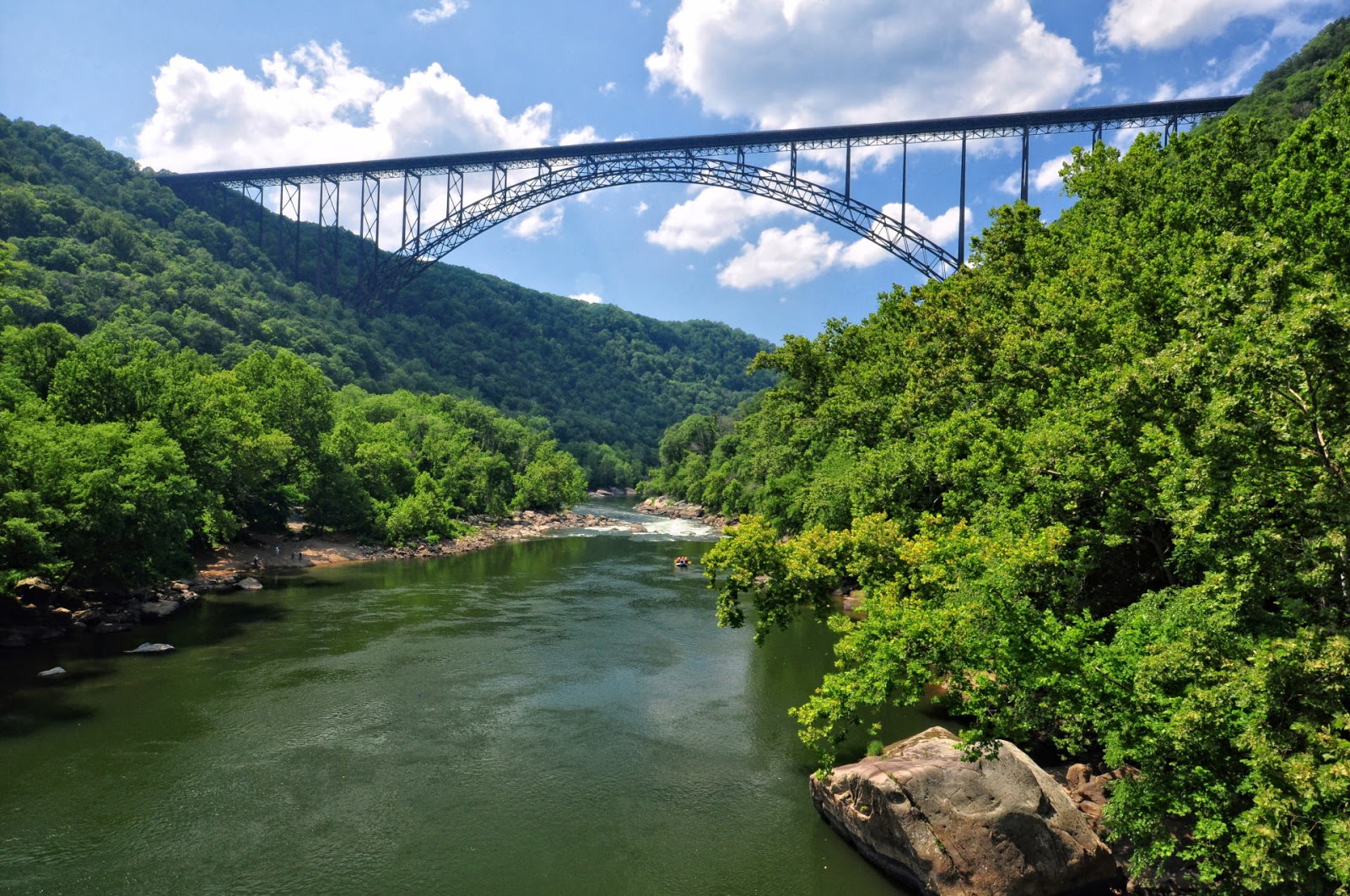
View from Fayette Station Bridge


Fayette Station Road

Fayette Station Road is a one-way, paved road that switchbacks its way down the north side of the New River Gorge and up the south side. The road goes under the New River Gorge Bridge twice, crosses the New River on Fayette Station Bridge, and has numerous views of the gorge and the river. Four-wheel drive isn’t needed for this road, and it’s the best route by car to get a feel for the beauty and majesty of the New River Gorge. Stop before you cross Fayette Station Bridge and walk out on the bridge for great views of the New River Bridge and Gorge. As you ascend the south side of the gorge look for a trailhead in the middle of a very wide switchback. This is the trailhead parking for NPS Fayetteville Trail (#5) and Kaymoor Trail (#8) (GPS: Lat. 38.05950, Long. -81.08051).
Wolf Creek Falls


Wolf Creek Falls

Wolf Creek Falls is below the road and a little downstream from the trailhead parking. Walking downhill on the outside edge of the switchback, you’ll notice a few indistinct paths dropping down to the creek. These will lead to Wolf Creek Falls. Be forewarned, the descent is steep, rocky, and choked with rhododendron. Wolf Creek Falls has a picturesque drop, massive boulders at the bottom, and a lovely, emerald-green plunge pool. Wolf Creek Falls is truly a hidden treasure of the New River Gorge. But then, there are many other such jewels in the gorge. So if you have a taste for adventure and discovery, head for the New River Gorge.
Wolf Creek Falls


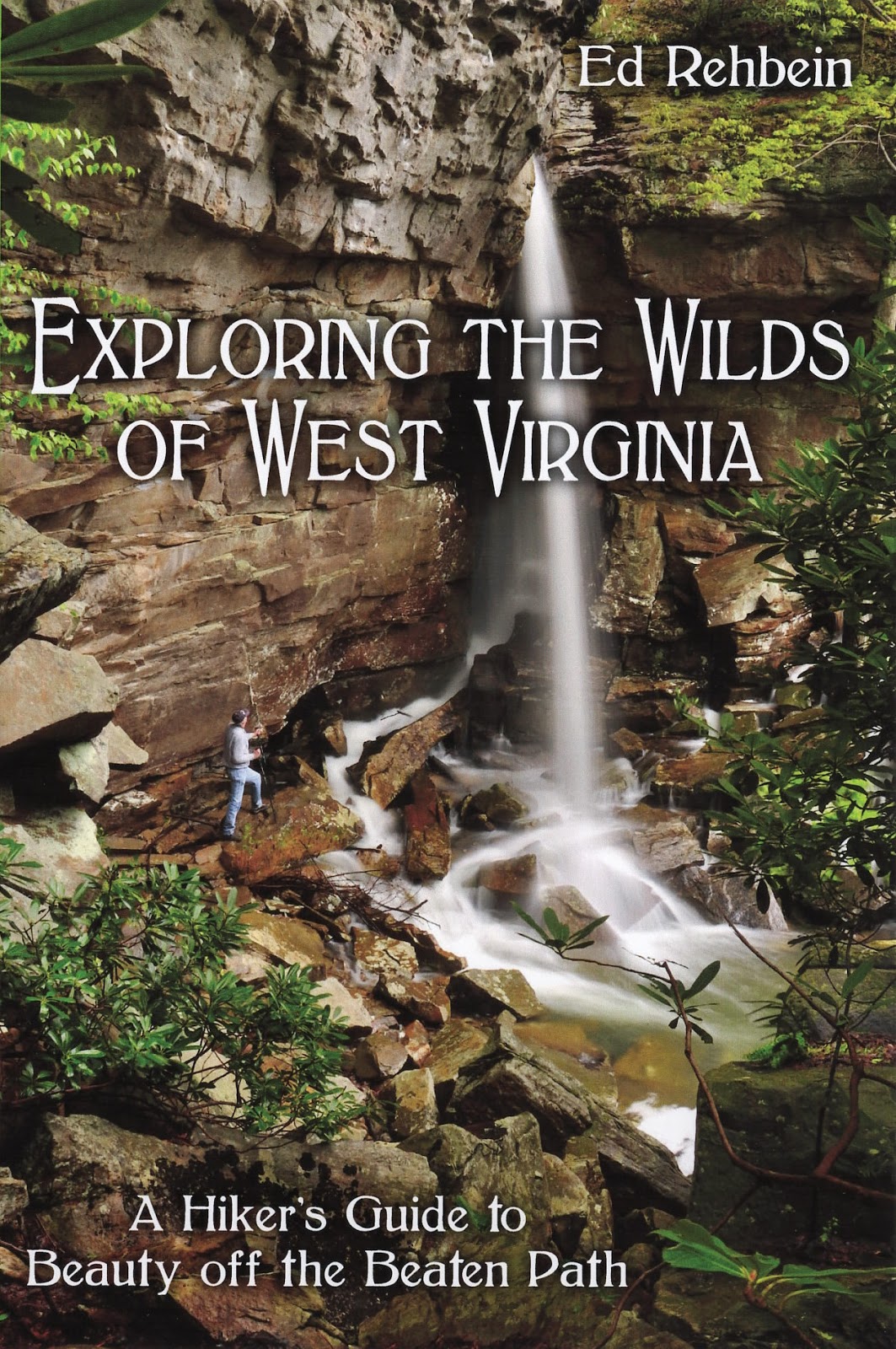
This and other waterfalls of the New River Gorge are highlighted in my new book, “Exploring the Wilds of West Virginia: A Hiker’s Guide to Beauty off the Beaten Path.” See a prior post about my book at NEW BOOK

New Book


Monday, January 23, 2017

The Wonder of White Oak Falls

“As I approached White Oak Falls on my second visit, a shaft of light was shifting across the face of the falls. I had to work fast to get this shot. I scampered up the rocks and into the basin below White Oak Falls, hurriedly set up my tripod in the stream bed, and, while trying to keep my wits, started shooting as quickly as possible. You just never know what you're going to find when you take a walk in the woods with your camera. The world changes day-by-day, minute-by-minute. How exciting!” from West Virginia Waterfalls: The New River Gorge by Ed Rehbein and Randall Sanger. Click HERE. 
White Oak Falls

The Great Mystic

White Oak Falls is the great mystic of southern West Virginia waterfalls. A beam of light seemingly sent from the heavens illuminates the falls adding a magical quality that few other waterfalls possess. What’s more it happens regularly—usually mid to late afternoon. Photographs of this blade of light crossing the face of White Oak Falls create a uniquely moody waterfall image.
White Oak Falls


Easy to Get There

White Oak Falls is both easy and difficult to get to. It’s easy in that it’s about a 1.75 mile hike from Brush Creek falls (described in an earlier post BRUSH CREEK FALLS). The trail is very gently graded and follows Brush Creek to its confluence with the Bluestone River. It then parallels the Bluestone River to its confluence with White Oak Creek. 
White Oak Falls


Difficult to Climb

It’s difficult in that the trail ends at the shores of the Bluestone where White Oak Creek meets the river. The lower falls of White Oak Creek begin right at the Bluestone, where White Oak Creek makes a couple of short drops and runs before flowing into the river. The upper falls, barely visible from the bottom, are sheltered by a large rock amphitheater protected on both sides by steep slopes.
White Oak Falls

Worth the Effort

Looking up at the falls, the right-hand side seems to be the easier path to the amphitheater. But there is a tight spot where you must hug a small round cliff to get upstream. It’s easier, but riskier. The left-hand side requires more climbing, mostly on very steep soil slopes, but I believe with a good pair of hiking boots, it’s the safer way. At any rate, it’s a difficult ascent but for the hale and hearty it’s worth the effort. 
White Oak Falls


For more about White Oak Falls see my new book “Exploring the Wilds of West Virginia: A Hiker’s Guide to Beauty off the Beaten Path.” Click here for a VIDEO and for more info or to purchase click HERE. 

Monday, January 16, 2017

Exploring the Rock Pinnacle at Meadow River

Towering sandstone cliffs, a boulder-lined riverbed, and rolling whitewater rapids–sounds like the New River. But it isn’t. And there’s more. A rock walled grotto, a 30-foot sandstone pinnacle, a little stone chapel, and a couple of waterfalls. Where is this place? I’m referring to the Lower Meadow River. In some respects, it’s like the New River and then some. Indeed, if I had only one day to hike in Southern West Virginia, I’d head for the Meadow River. It offers so much and is so accessible. In my new book “Exploring the Wilds of West Virginia,” I point out a couple of hikes and points of interest along the Meadow River. Let me mention one of those in this blog—the sandstone pinnacle. 
Meadow River


How Do You Get There?

So how do you get to this wild river? It’s surprisingly easy. The best access is at the Kevin Ritchie Memorial Bridge, which crosses the Meadow River on U.S. Highway 19. While driving U.S. 19, I noticed from time to time a few cars parked off the berm just north of the bridge (GPS: Lat. 38.15305, Long. - 80.92434). I made a mental note to check it out some day. And my only regret is that I didn’t do it sooner. As it turns out, this is a great spot from which to explore the Meadow River both upstream and downstream. By the way, if you enjoy exploring areas that are off the beaten path, then be watchful for parking spots such as this one. They may lead you to some interesting places.

At any rate, hike down the dirt road that parallels U.S. 19. After passing a waterfall on your left, a few yards further down look for an obvious fork in the road. It’s next to a large rock outcrop with an overhanging ledge. The left fork is the best way to explore the Meadow River upstream. Take this road to its end at the Meadow River and turn left on a road that runs along the north side of the river. 
The First Buttress


Upper Meadow Walls

To explore the upstream cliffs called the “Upper Meadow Walls,” hike the road for about three quarters of a mile. Look for a faint path breaking off to the left toward the cliffs. If you come to a little camp by the river’s edge, you’ve gone too far. Backtrack about 80 paces to find the trail to the cliffs. 
The Pinnacle


The Pinnacle

The trail leads to the base of one of the tallest set of cliffs that I’ve seen in the New River Region. Called the First Buttress, it’s a vertical to slightly overhanging wall of sandstone some 120 to 140 feet high. The wall is orange and brown from weathering and will have you craning your neck to appreciate it. Continue to the right along the base of the cliffs to the Second Buttress, and remember there are surprises around every corner. In this case, you’ll be amazed by a column of sandstone some 30 to 40 feet high. Pinnacles or pillars of stone are fairly rare around here and are exciting to find. This one is mushroom shaped with a tree growing on top. The pinnacle guards the entrance to a deep V-shaped notch in the cliff wall. This secluded cove of stone, called the “Grotto” by rock climbers, has a couple of small caves, some overhanging roofs of stone, and a trickle of water down the back wall. 
The Pinnacle

There’s much more to explore at the Meadow River all of which is covered in my new book “Exploring the Wilds of West Virginia: A Hiker’s Guide to Beauty off the Beaten Path.” 

For more info or to order book online click HERE.

Saturday, January 7, 2017

Fascinating Places Described in “Exploring the Wilds of West Virginia”

A New World Emerges at Summersville Lake 

When the Corps lowers the water to winter levels at Summersville Lake, fascinating landscapes emerge. Nestled in the woodlands of West Virginia, an island of dry, desiccated, desert-like scenes arise from the once water-covered land. 
Long Point

Beautiful Boulders

Perhaps the first thing you’ll notice are bold, beautiful, snow-white boulders of all shapes and sizes. The rocks are rough and angular and piled chaotically. It’s like a scene from another world. The rocks are brilliant white because they’re below the water level during the summer and being submerged for so much of the year, they aren’t stained by the oxidation and weathering of iron-bearing minerals. So the rocks are in their most pristine state. 
Long Point

Stunning Cliffs

These beautiful boulders have fallen from the gorgeous cliffs that circle Summersville Lake. Long Point stands out like a stone fortress. It’s a photographer’s delight presenting dramatic poses from several viewpoints. At Pirate’s Cove a waterfall pours over the cliffs, and at Whippoorwill trees precariously cling to the cliffs. 
Long Point


Phantom Forests

You’ll also notice tree stumps poking up between the boulders. The stumps were left when the Corps cleared the slopes of the lake in the early 1960's prior to filling it. Since all the soil has been winnowed away by the waters of the lake, the roots of the trees have been laid bare and resemble the arms of an octopus. The textures of the tree stumps are fascinating, too. The bark is gone, but the wood beneath is not rotten. Rather it’s dried, cracked, and desiccated and either chocolate brown or silver gray in color. A cluster of these old tree stumps looks like a phantom forest. 
Pirate's Cove

Three Handy Access Points

So how do you see these unusual sights? Three handy access points are described in “Exploring the Wilds of West Virginia.” One is Long Point, which is reached by a 1.75 mile trail that starts near the archery range at the lake. Second is near Pirate’s Cove. The trailhead is just north of the US 19 bridge crossing the lake. And the third is off Whippoorwill Road just south of the bridge. All three hikes are described in detail in the book.
Whippoorwill


As I mentioned, the terrain below the water level at the lake resembles a desert. The rocks are bare and craggy, and the vegetation is sparse. If you didn’t know better, you might think you were in Arizona or New Mexico. But for West Virginia, it truly is a new world.
Pirate's Cove
For more information about the book or to purchase click HERE

Monday, December 19, 2016

Six Waterfalls of the Midland Trail

“The Midland Trail is more than a road; it’s a virtual history book. Originally a crude pathway worn by buffalo and the early pioneers, it stretches from White Sulphur Springs westward to Kenova, zigzagging along rivers, over mountains and through lush valleys. Along the way it touches just about every aspect and time period of West Virginia’s story—coal mines and chemical plants, Civil War battlefields and historic churches, ancient Native American burial mounds and African-American slave quarters” (Highway to History, by James E. Casto).

To celebrate this historic road, I’ve chosen to highlight some of the waterfalls that line U.S. 60 from just east of Gauley Bridge to Charlton Heights. Some of these waterfalls, like Cathedral Falls, are well-known landmarks. But most are smaller and lesser known seasonal waterfalls that flow best in the winter and spring months during periods of rain and thaw. Although they don’t run all year long, when in season, these waterfalls are as pretty as any the State has to offer. So starting at Cathedral Falls and running west on U.S. 60 here are photographs of six waterfalls along the Midland Trail.

Cathedral Falls

Cathedral Falls

Cathedral Falls is located at a roadside stop a mile east of Gauley Bridge on US 60. This is one of the premier waterfalls of West Virginia. Lucia Hyde Robinson mentions in her Forward in West Virginia Waterfalls: The New River Gorge, a book of waterfall photography by Randall Sanger and me, that Cathedral Falls might have been named by her father, the renowned West Virginia photographer, Arnout Hyde, Jr. That would be fitting because more than any single individual, Arnout Hyde, Jr. popularized the natural beauty of West Virginia.
Hidden Falls

Hidden Falls

Lying on Laurel Branch, Hidden Falls is about a half a mile west of Cathedral Falls on U.S. 60. To be sure, this waterfall seems unimpressive, if visible at all, from the highway--thus the name Hidden Falls. But there are pull-offs on the river side of the highway for parking, and the hike up to the falls is short. Your hike will be rewarded by a waterfall with a single vertical drop of about 60 feet. Hidden Falls has the distinction of being the last waterfall in the New River Gorge. Just a half a mile downstream, the New River merges with the Gauley River to become the Kanawha River. In addition to being the last waterfall in the Gorge, it just might be the tallest, too. 
Riggs Branch Falls

Riggs Branch Falls

Another hidden, but very attractive waterfall lies on Riggs Branch just off of U.S. 60 about a half a mile west of the Glen Ferris Inn. There’s a large parking area on the river side of the road just before the highway crosses the railroad tracks. This is the safest place to park since the shoulders of U.S. 60 are quite narrow and the highway is close to the rail line at Riggs Branch. The falls at Riggs Branch are protected in a narrow cove in the sandstone cliffs near the road. 
The watershed for Riggs Branch is even smaller than that of Laurel Creek, so the best time to visit is definitely in late winter or early spring. Although not as tall as the waterfall at Laurel Branch, when the water is running well, Riggs Branch Falls are very photogenic. Half way down its vertical plunge, the waterfall strikes a hollowed out ledge in the sandstone cliff. Hitting this ledge, the water is thrust up and out before making the last vertical descent into the plunge pool. The effect is striking and dramatic making it a wonderful waterfall to photograph.
Seasonal Falls

Seasonal Waterfall

Just 2000 feet south of Riggs Branch Falls lies an attractive seasonal waterfall. Its watershed is small, so it’s best to catch it after a very heavy rainfall or several days of steady rain. Nevertheless, when the creek is full, the waterfall is quite pretty. It stair-steps over several sandstone ledges as it descends to the Kanawha River. It’s easy to find as a large pullout is right at the falls. 
Lower Wall Falls

Wall Falls

About a mile south of the previous waterfall on U.S. 60 and just before the town of Charlton lies a waterfall I’ve dubbed the “Wall Falls.” At the head of the waterfall is a wall about 20 feet high constructed of stone blocks. Although I’ve asked, no one yet has been able to tell me why the wall was built. It does form a retaining wall for the creek crossing of an old road that sits atop the wall and perhaps that’s its purpose. The watershed for this falls is quite small, so you have to also catch it in periods of heavy flow.  If you climb to the top of the wall, at Wall Falls, you’re treated with a second waterfall that descends in stair-step fashion over a substantial drop. So the Wall Falls are really two waterfalls in one. 
Upper Wall Falls
This brings our tour of the waterfalls of the Midland Trail to a close. These seasonal waterfalls along U.S 60 are at their very best in late winter and early spring. When winter seems to be its dreariest, I suggest you take a drive along the historic Midland Trail and visit these beautiful waterfalls

Monday, December 5, 2016

Five Waterfalls of the New River Gorge

Nestled in the steep slopes of the New River Gorge are hundreds of rugged waterfalls. These waterfalls are fertile ground for nature lovers offering challenging hikes and striking landscapes. Having published a photo book of the waterfalls of the New River Gorge, I’d like to share five of those waterfalls that really stand out. 


Cathedral Falls

Let’s start with picturesque Cathedral Falls, which is located on US Highway 60 one mile east of Gauley Bridge, WV. Since the falls are located at a roadside rest stop, access is easy. You can literally step out of your vehicle and start photographing the falls. Descending 60 feet in a series of three dramatic drops within a large semi-circular rock amphitheater, Cathedral Falls is as photogenic as they come. Easy access generally means plenty of visitors and photographers, so you have to be patient and creative to get a photograph. To eliminate people in the foreground, I generally work my way around the left side of the rock amphitheater for close-ups of the falls. 
Cathedral Falls

Turkey Creek Falls

The next waterfall is only six miles down the road. From the parking lot at Cathedral Falls, turn left onto US Highway 60 and drive to Hawks Nest State Park. From the State Park Lodge take the tram from the cliff top down to Hawks Nest Lake. From the tram station pick up the Fisherman’s Trail, which skirts the northern shore of Hawks Nest Lake. A pleasant 0.8 mile walk along the lake ends at the falls on Turkey Creek. This waterfall is best photographed after some heavy summer rains. At full flow the falls split into three segments at the top, which merge in the middle and split again into three segments at the base. Total drop is about 35 feet. 
Turkey Creek Falls

Fern Creek Falls

The next stop is one of the classiest and most unique waterfalls in the Gorge. Starting at the parking lot at the Canyon Rim Visitor Center, turn right out of the lot and drive 1/10 of a mile. Make a very sharp right hand turn, and proceed downhill another 1/10 of a mile to the junction with Fayette Station Road. Turn left and go yet another 1/10 of a mile to a pull out on the right-hand shoulder of the road, which is the trail head parking. It’s only a mile to Fern Creek Falls, but the trail is rocky and uneven. Indeed the path is merely a bushwhacked trace forged by rock climbers seeking access to the base of the cliffs that rim the uppermost portion of the Gorge. Although the trail forks from place to place, if you hug the base of the cliffs, called the Endless Wall, you won’t go wrong. The trail ends at the falls, so you can’t miss them. 

Flanked by the 60 foot high Endless Wall, Fern Creek Falls epitomize a New River Gorge waterfall—rough and rocky. Fern Creek Falls are really two falls in one. During average runoff, the falls are confined to a deep, vertical cleft in the cliff. At high water, the best time to visit the falls, part of the waterfall shoots over the cliff edge and plunges for about 50 feet into a pool below. 
Fern Creek Falls


Wolf Creek Falls

The next waterfall is just across the Gorge. From the Fern Creek trailhead parking, backtrack and drive down Fayette Station Road, which goes under the New River Gorge Bridge, winds down the side of the canyon, and crosses the New River at Fayette Station Bridge. After crossing Fayette Station Bridge, drive one mile to the second hairpin curve in the road. There’s parking in the curve for the Kaymour Trailhead. Wolf Creek parallels the road at this point and is well named. It’s a untamed torrent that charges down the slopes of the New River Gorge like a wild animal. 

Not surprisingly, Wolf Creek Falls are rough and rugged, too. They aren’t visible from the road, so most visitors drive right passed them. The falls are below the road and a little downstream from the trailhead parking. Walk downhill on the outside edge of the switchback in the road until you notice a few indistinct paths dropping down to the creek. These lead to Wolf Creek Falls. Be forewarned; the descent is short, but steep, rocky, and choked with rhododendron. The bushwhack trail opens up halfway down with spectacular views of the falls to your right. Making your way to the base of the falls, you can enjoy the emerald-green plunge pool and vividly colored boulders. 
Wolf Creek Falls


Sandstone Falls

No tour of the New River Gorge waterfalls would be complete without a stop at Sandstone Falls. According to a database of waterfalls world-wide, Sandstone Falls rank 19th by width and 33rd by volume. In Hinton at the end of the bridge crossing the New River, turn right and take the River Road for 9 miles to Sandstone Falls. There are plenty of good viewpoints of the New River along the way, including a roadside picnic area at Brooks Falls, about half way up the road to Sandstone Falls.

Sandstone Falls are easily explored by a ¼ mile, handicapped accessible boardwalk that crosses two bridges and leads to islands and observation decks offering views of the falls. But for the finest views, it’s best to leave the boardwalk for a little off trail scrambling. Just a few feet before the end of the boardwalk, there’s a path leading to the right. It leads to a shallow water crossing and onto an island. At this point, I prefer to bear a little to the left and head toward the river bank. This takes you to two more small water courses that separate islands and puts you on the lead island that sits right in front of Sandstone Falls. The falls can be viewed along the full length of the upstream edge of the island, which is fortunate, because Sandstone Falls are not just one waterfall, but many. The main falls are more than 800 feet wide, average 20 feet high, and are composed of many segments of distinctive character. To me this is one of the most magnificent views in all of West Virginia. 
Sandstone Falls

Many more falls line the New River Gorge, but I hope these five whet your appetite for waterfall hunting in the Gorge.  Sandstone Falls   Marr Branch Falls
New River Gorge Waterfalls Photo Book   Ramsey Branch Falls   
Pipestem Falls   Elakala Falls   Brush Creek Falls

Thursday, December 1, 2016

Hiking Long Point: A Doorway to a New World

If you’re looking for something unusual, exotic even, in a West Virginia landscape, Long Point is just the ticket. Long Point is a rugged promontory of sandstone that juts like a fortress into Summersville Lake, a 2800-acre impoundment in Nicholas County, West Virginia, just off US Route 19. During weekends in September and October, water is released from the dam into the Gauley River to provide plenty of white water and rapids for rafters and kayakers. The lake level is eventually lowered by 75 feet to its winter pool elevation of 1,575. The landscape below normal lake level is stunning, and hiking and exploring it will leave you awed. 


The Long Point Trail

The Long Point trailhead (GPS: Lat. 38.23387, Long. -80.86593) is located at an archery range near the Summersville Airport. Before you leave your vehicle, make sure you’ve packed a camera because you’re going to be rewarded with a visual feast! It’s an easy 1.8 mile hike out to Long Point as the trail gently undulates through the forest. It follows an old road for about a half a mile before branching off along a broad ridge that progressively narrows as you approach Long Point. The Corps of Engineers has placed signposts at ½ mile intervals, so you can easily measure your progress. 
Long Point
At the trail’s end a sign is posted saying: “Warning, Trail Ends Here.” It doesn’t. But it does mean that you have to be careful, for beyond the sign you’ll be near sheer rock cliffs and open fissures in the rocks. Don’t be put off by this. Just watch your step for the next 50 to 100 feet, and you’ll walk out onto the tip of Long Point. 


At the Point

Now it’s time to get your camera out. The promontory at Long Point once sat above a sweeping, horseshoe bend in the Gauley River. Now it stands as a castle surrounded by Summersville Lake. At the end of the point, you’re treated to a nearly 360-degree panorama of sky, rock, and water. 
Long Point
At this point, you will have been well rewarded for your efforts, but quite frankly the best is ahead. When you’ve soaked in all the scenery at Long Point, return to the sign marking the end of the trail. From the sign post pace off 150 steps along the trail away from the point. This should put you close to two small pine trees growing about a foot apart. Turn to the left and follow a “bush-wacked” trail–a path worn down by occasional hikers. It leads to a depression near the edge of the cliff. 


Descend in the Cleft

Now here’s where nature has been kind. The cliffs at Long Point are shear and steep, over 100 feet high, and normally only rock climbers could scale down to the base of them. But to the left of the depression you’ll find the head of a narrow cleft in the massive rock walls of the cliffs. This crevice is like an enclosed stairway which runs from the top of the cliff to the bottom. It’s easy to negotiate and not a bit dangerous. In fact, the rock walls surround you as you descend. 


Emerge in a New World

You emerge from the crevice at the base of the cliffs. If you’re visiting Long Point during low water levels between November and April, then hold your breath because you’re about to enter a landscape unlike any other in West Virginia. As you emerge from the crevice, perhaps the first thing you’ll notice are bold, beautiful, snow-white boulders of all shapes and sizes. The rocks are rough, angular, and piled chaotically. It’s like a scene from another planet or a lunar landscape. The rocks are brilliant white because they’re below the water level during the summer, and being submerged for so much of the year, they aren’t stained by the oxidation and weathering of iron-bearing minerals. So the rocks are in their most pristine state.

You’ll also notice tree stumps poking up between the boulders. The stumps were left when the Corps cleared the slopes of the lake in the early 1960's. Since all the soil has been winnowed away by the waters of the lake, the roots of the trees have been laid bare and resemble the arms of an octopus. The textures of the tree stumps are fascinating, too. The bark is gone, but the wood beneath is not rotten. Rather it’s dried, cracked, and desiccated and either chocolate brown or silver gray in color. In some ways, the environment below the water level at the lake resembles something out of the desert southwest. The rocks are bare and craggy, and the vegetation is sparse. If you didn’t know better, you might think you were in Arizona or New Mexico. It is truly a new world.


Hike Around Long Point

Even though the terrain is rough and rocky, with care you can hike through it. If you walk to the left (east), you’ll catch your first glimpse of Long Point towering above you. Long Point is naturally photogenic. This dazzling promontory invites photography. As you make your way around the promontory, it changes character, presenting new facets, and seems to pose for pictures–all striking and inspiring. 
Long Point

After rounding the bend below Long Point, double back and explore the ground just below the point. You’ll find arches, crevices, and a giant chamber enclosed by steep walls of stone. Once you’ve taken in all the scenery you can, make your way back to the cleft. You can’t miss it. It’s behind a huge pyramid of stone–a block of sandstone that’s fallen from the cliffs and now lies on its side.
Long Point

A Temple of Stone 

John Muir fell in love with Cathedral Peak in the Sierra Nevada Mountains of California and wrote of it: “From every point of view it shows marked individuality. It is a majestic temple of one stone, hewn from the living rock.” Perhaps you’ll feel the same about Long Point. I do.